Showing posts with label gnugk. Show all posts

Thursday, July 2, 2026

GNU Gatekeeper 5.15 released

 *** This is a security update ***

Download: https://www.gnugk.org/h323download.html

Serveral issues related to authentication features have been fixed.

Besides the security updates, another bug has been fix to respect the InternalNetworks setting when the ExternalIP setting is active.


Changes from 5.14 to 5.15
=========================
- BUGFIX(authenticators.cxx) small fixes to H235AuthDesECB and H235AuthDesCTS
- BUGFIX(ipauth.cxx) fix checking prefixes
- BUGFIX(sqlauth.cxx) don't accept empty passwords
- BUGFIX(gkauth.cxx) fix in Q.931 authentication
- BUGFIX(gkauth.cxx) fix auth cache expiry
- disable command execution for port notifications unless the feature is explicitely activated by ./configure --enable-port-notification-exec
- BUGFIX(GkStatus.cxx) improve ssh status port authentication
- BUGFIX(ProxyChannel.cxx) make sure we respect InternalNetworks= when using ExternalIP=

Friday, November 7, 2025

GNU Gatekeeper 5.14 released


GNU Gatekeeper version 5.14 has been released.

Download: https://www.gnugk.org/h323download.html

This is mostly a bug fixing release, but it also updates the Amazon AWS IP detection to the current standard.

Changes from 5.13 to 5.14
=========================
- update AWS IP detection to IMDSv2
- BUGFIX(RasTbl.h) fix potential memory leak
- BUGFIX(h323utils.cxx) fix detection of 'site local' and 'unique local' IPv6 addresses
- BUGFIX(Makefile.in) restore compatibility with GCC 4, 5 and 6
- BUGFIX(Toolkit.cxx) restore compatibility with very old versions of OpenSSL
- BUGFIX(h323utils.cxx) fix numeric overflow
- BUGFIX(Toolkit.cxx) fix iterator usage (found by Coverity)


Saturday, October 19, 2024

GNU Gatekeeper 5.13 released

GNU Gatekeeper version 5.13 has been released.

Download: https://www.gnugk.org/h323download.html

This is a bug fix release with a no new features added. It fixes an issue with the RTP port detection and 2 other minor issues.


Monday, February 19, 2024

GNU Gatekeeper 5.12 released

 GNU Gatekeeper version 5.12 has been released.

Download: https://www.gnugk.org/h323downldad.html

This is a bug fix release with a few new features added.

Another important bug in the handling of the ExternalIP switch has been fixed as well as Y2K38 issues.

This release also adds features:

  • support for Oracle databases
  • easier cloud deployment with IP detection with STUN
  • better load scaling by mixing proxied with direct mode endpoints in a single gatekeeper
  • Windows 64bit executables with VS2022

Full list of changes:
  • enable more runtime hardening flags from OpenSSF recommendation 11/2023
  • fix bug with H.245 address when using ExternalIP= switch without H.460.18/.19
  • auto-detect public IP with ExternalIP=STUN and STUNServer=stun.example.com
  • compiler support for VS2022
  • new database driver for Oracle and new timestamp format 'Oracle'
  • new switch [EP::xxx] ForceDirectMode=1 to handle all calls from this endpoint in direct mode
  • BUGFIX(RasSrv.cxx, gkauth.cxx) make sure time_t is handled unsigned to avoid Y2K38 issue
  • BUGFIX(ProxyChannel.cxx) check for too small packets when acting as encryption proxy


Monday, February 20, 2023

GNU Gatekeeper 5.11 released

GNU Gatekeeper version 5.11 has been released.

Download: https://www.gnugk.org/h323download.html

This is a bug fix release with a few new features added.

An important bug in the handling of the ExternalIP switch has been fixed.

We also added a few features that make it easier to use GnuGk with Graphana and InfluxDB monitoring.

Changes and additions:

  • remove non-working command line switch -e / --externalip, use config file to set ExternalIP
  • new accounting variables %{registrations}, %{calls}, %{total-calls}, %{successful-calls}, %{allocated-bandwidth}
  • new switch [HttpAcct] Authorization= to send authorization headers to support InfluxDB
  • replace \r and \n in HttpAcct body with carriage return and line feed characters
  • new switch: [RasSrv::LRQFeatures] PreserveDestination=1 (helpful when calling Pexip servers)


Wednesday, August 24, 2022

GNU Gatekeeper 5.10 released


GNU Gatekeeper version 5.10 has been released.

Download: https://www.gnugk.org/h323download.html

This is a bug fix release.

Bugs fixed:

  • fix a crash when handling the MasterSlaveDetermination message
  • fix the documentation of [RasSrv::LRQFeatures] NeighborTimeout and consistently treat the value as 10th of a second in the program

Tuesday, October 26, 2021

GNU Gatekeeper 5.9 released

GNU Gatekeeper version 5.9 is out with a number of bug fixes and a few new features.

Download: https://www.gnugk.org/h323download.html

New features:

  • new switches [Proxy] CachePortDetection=1 and CachePortDetectionDuration= to cache port detection packets for faster media connects when IgnoreSignaledIPs= is active
  • new switch: [EP::] ForceTerminalType=
  • new place holder for port notifications: %t for port type
  • experimental: better error recovery if multiplexed RTP sending fails

Please note that Radius support is disabled by default now. You can enable it with the --enable-radius switch when running configure.

Bug fixes:

  • fix bug in port detection with AllowSignaledIPsFrom=
  • when DNS name resolves to IP without alias, remove alias from ACF completely (Cisco interop)
  • remove RTP session 0 from internal tables once H.245 master has assigned a session ID
  • fix compilation of Avaya support
  • initialized cmsg struct to zero before using
  • fix regression introduced with MatchH239SessionsByIDOnly= switch


Thursday, July 22, 2021

GNU Gatekeeper 5.8 released

GNU Gatekeeper version 5.8 has been released with a number of bug fixes and a few new features.

To stay updated on new releases, please also follow us on Twitter!

Improved interoperability with:

  • EdgeProtect
  • Avaya

 New features:

  • experimental support for Avaya's non-standard version of H.323 (./configure --enable-avaya) (thanks Konstantin Prokazov)
  • consider RFC 6598 shared network space (100.64.0.0/10) and Zeroconf (169.254.0.0/16) as private IPs
  • new switch [Proxy] AllowSignaledIPsFrom= to skip auto-detect for messages received directly from certain IPs when IgnoreSignaledIPs=1
  • new switch [Proxy] AllowAnyRTPSourcePortForH239From= to handle incorrect RTCP addresses in H.239 OLC (EdgeProtect interop)
  • new switch [RoutedMode] MatchH239SessionsByIDOnly= to never attempt to match a H.239 reverse channel by type for improved interoperability with EdgeProtect
  • new switches to set the HTTP Content-Type header in HttpAcct, HttpPasswordAuth and Routing::Http
  • new switch [Routing::Http] JSONResponse=1 to send more flexible routing data in the HTML reponses
  • many new status port shortcuts (see manual section for details)

Bug fixes:

  • fix H.460.18/.19 on multi-homed servers
  • fix race condition when handling H.460.19 multiplex IDs
  • fix media loop on half port-detected channel when media is very early
  • fix Net-SNMP query for total bandwidth
  • save RTCP address from OLC for port-detection
  • always check AllowSignaledIPs= before applying IgnoreSignaledAllH239IPs or IgnoreSignaledPrivateH239IPs
  • handle extensions and CSRC in RTP header with H.235 half-call media
  • better endpointIDs on Windows when compiling without OpenSSL


Tuesday, January 19, 2021

H.323: IPv4 to IPv6 migration

Many networks are migrating from IPv4 to IPv6. What can you do if still have H.323 endpoints that only support IPv4 ?

The GNU Gatekeeper can translate IPv4 into IPv6 calls and vice versa.
You can use one GnuGk to IPv6 enable all of your existing IPv4 endpoints.


All you have to do is enable IPv6 in your configuration and GnuGk will automatically
detect the connection type of your endpoints and convert the call.

All it takes is one switch in your config:

[Gatekeeper::Main]
EnableIPv6=1 
 

Wednesday, January 13, 2021

Using the GNU Gatekeeper to create TLS tunnels

Most H.323 vendors did not implement encrypting the signaling connection with TLS. They only encrypt the media (RTP). But you can use the two GNU Gatekeepers to encrypt you call signaling even when your endpoints don't support this natively.

Suppose you have 2 locations and want to connect them securely over the public internet.

GnuGk can encrypt call signalling between those locations using TLS and encrypt the media (RTP) using H.235.6 (AES encryption). 


 Configuration for GNU Gatekeeper 1 (prefix 01)


[Gatekeeper::Main]

[RoutedMode]
GKRouted=1
H245Routed=1
CallSignalPort=1720
AcceptUnregisteredCalls=1
; make sure H.245 gets tunneled for TLS
H245TunnelingTranslation=1
; add AES media encryption if the endpoint doesn't encrypt itself
EnableH235HalfCallMedia=1
; only allow encrypted calls
RequireH235HalfCallMedia=1
; change the media key after 2^31 operations
EnableH235HalfCallMediaKeyUpdates=1

[Proxy]
Enable=1

[ModeSelection]
0.0.0.0/0=PROXY
; only use routed mode for local calls
192.168.0.0/18=H245ROUTED

[TLS]
EnableTLS=1
PrivateKey=/path/to/server.pem
Certificates=/path/to/server.pem
CAFile=/path/to/rootcert.pem
Passphrase=MySecret
CheckCertificateIP=1

[Gatekeeper::Auth]
FileIPAuth=required;Setup

[FileIPAuth]
; allow all calls from local network
192.168.1.0/24=allow
; only allow TLS encrypted and authenticated calls from elsewhere
any=onlyTLS

[RasSrv::PermanentEndpoints]
; the GnuGk in the other location, serving prefix 02
1.2.3.4:1300=remote-gw;02

[EP::remote-gw]
; use TLS to call remote GnuGk
UseTLS=1 
 

Configuration for GNU Gatekeeper 2 (prefix 02)

[Gatekeeper::Main]

[RoutedMode]
GKRouted=1
H245Routed=1
CallSignalPort=1720
AcceptUnregisteredCalls=1
; make sure H.245 gets tunneled for TLS
H245TunnelingTranslation=1
; add AES media encryption if the endpoint doesn't encrypt itself
EnableH235HalfCallMedia=1
; only allow encrypted calls
RequireH235HalfCallMedia=1
; change the media key after 2^31 operations
EnableH235HalfCallMediaKeyUpdates=1

[Proxy]
Enable=1

[ModeSelection]
0.0.0.0/0=PROXY
; only use routed mode for local calls
192.168.0.0/18=H245ROUTED

[TLS]
EnableTLS=1
PrivateKey=/path/to/server.pem
Certificates=/path/to/server.pem
CAFile=/path/to/rootcert.pem
Passphrase=MySecret
CheckCertificateIP=1

[Gatekeeper::Auth]
FileIPAuth=required;Setup

[FileIPAuth]
; allow all calls from local network
192.168.1.0/24=allow
; only allow TLS encrypted and authenticated calls from elsewhere
any=onlyTLS

[RasSrv::PermanentEndpoints]
; the GnuGk in the other location, serving prefix 01
1.2.3.5:1300=remote-gw;01

[EP::remote-gw]
; use TLS to call remote GnuGk
UseTLS=1 
 

Other options

You could also configure the remote GNU Gatekeeper as a neighbor, but beware that the RAS traffic between neighbors will show meta data (whois is caling who) in clear text! 

See the GnuGk manual section on TLS for more details and examples how to generate the OpenSSL certificates. 


Thursday, October 29, 2020

GNU Gatekeeper 5.6 released

Today GNU Gatekeeper version 5.6 has  been released.

Download: https://www.gnugk.org/h323download.html

It contains an important bug fix to H.460.19 multiplexing and H.460.26 (media over TCP) when using GnuGk's internal call forwarding (ForwadOnFacility).

I have also added an interop tweak to be able to call video services that don't understand H.323 URL aliases (eg. videobutler.nl). You can enable it with

[Routing::SRV]
ConvertURLs=1

Here is the full changelog:

  • new switch: [Routing::SRV] ConvertURLs=1 to convert URL_IDs into H323_IDs
  • BUGFIX(ProxyChannel.cxx) fix RTP multiplexing and H.460.26 when ForwardOnFacility is used
  • BUGFIX(ProxyChannel.cxx) remove H.460.19 feature from Setup when using ForwardOnFacility=1
  • new switch: [Gatekeeper::Main] GrantAllBRQ=1 to accept any BRQ, even if the conferenceID is invalid


Tuesday, January 7, 2020

GNU Gatekeeper 5.4 released

I am happy to announce the release of GNU Gatekeeper 5.4.

You can download it from https://www.gnugk.org/h323download.html

New features:
  • new accounting module to send accounting data to an MQTT server
  • support for redis as database (eg. as backend for password storage)

Bug fixes:
  • important fix for H.245 tunneling translation with H.460.18 endpoints
  • fix for snmpwalk in PTLib-SNMP implementation
  • fix sending alternate gatekeeper list to endpoints with assigned gatekeeper
  • improved DRQ from child gatekeepers
  • fix TLS with neighbor gatekeeper


Please also note that a bug has been found in PTLib that can cause a crash in any GnuGk version if you use the status port (manually of from an application). Please upgrade to PTLib 2.10.9.3!

Monday, August 12, 2019

Howto block H.323 spam calls with fail2ban

When you run the GNU Gatekeeper, you can block spam calls from the well known bots ("MERA RU", "SimpleOPAL" etc.) eg. using a small LUA script in your config.

But that alone doesn't stop the load on the server, because often these bots keep on making calls.

Fail2ban to the rescue!

With this filter definition in /etc/fail2ban/filter.d/gnugk.conf you can check fro rejected calls:

[Definition]
failregex = Dropping call CRV=[0-9]+ from <HOST>:[0-9]+ due to Setup authentication failure
ignoreregex =


And then you can add this jail definition to /etc/fail2ban/jail.local to block the IP:

[gnugk]
enabled  = true
logpath  = /var/log/gnugk.log
filter   = gnugk
bantime  = 6000
maxretry = 2
action   = iptables[name=GnuGk, port=1720, protocol=tcp]


Voila!

Wednesday, June 5, 2019

Celebrating 20 Years of GnuGk

20 years

20 years ago, in June 1999, I released the first version of the GNU Gatekeeper. Back then we still called it "OpenH323 Gatekeeper".

The first version was very simple and only supported RAS and what we call 'direct mode' today, but it still seems useful to people and within a year it grew into a tool that people used in production.

I quit my day job in 2003 to work full time on GnuGk and it has feed the family ever since. I am still amazed how well it works to give software away for free. How many people and companies contribute and give feedback and how many are willing to pay for support or new
features.

I want to thank everybody who used it, provided feedback, bug fixes and ideas to make it into the great software that it is today!

We are not stopping here, the next release is already underway with many improvements and new features. Watch for it!

Happy Birthday GnuGk!

Friday, August 17, 2018

GNU Gatekeeper 5.0 released

I'm happy to announce the release of GNU Gatekeeper version 5.0.

This version has new features and a few bug fixes. You can download it from https://www.gnugk.org/h323download.html

Whats new ?

  • support for Azure and Alibaba Cloud in addition to AWS
  • performance optimizations, especially for multiplexed RTP and LUA
  • compatible with OpenSSL 1.1.x
  • switch to translate Facility transfers into gatekeeper TCS0 reroutes

There were also a number of bug fixes, please see changes.txt for
details.

Enjoy!

Thursday, April 5, 2018

GNU Gatekeeper 4.9 released

This version has new features and a few bug fixes. You can  download it from
https://www.gnugk.org/h323download.html

Whats new ?

We have 2 new accounting modules: HtttpAcct and AMQPAcct that allow
you to send accounting events via HTTP GET or POST to a web service
or push them into a RabbitMQ queue.

There are also many new accounting placeholders that you can use with
any of the accounting modules and there is a new accounting event
'reject' to track calls rejected with ARJ that went unnoticed before.

The new RTP inactivity checking allows you to drop calls if there
wasn't any RTP activity for a defined amount of time.

GeoIP authentication has been significantly updated to support all
RAS and all Q.931 messages and to support the new Maxmind database
format (GeoIP2).

There were also a few bug fixes:
  • fix crash while handling RTP packets
  • fix disconnecting unregistered endpoints
  • fix crash in some Avaya endpoints when receiving GCF with a gatekeeperIdentifier
  • fix crash when using IPv6
  • fix handling of CloseLogicalChannel

Wednesday, March 21, 2018

What to do when your H.323 videoconferencing equipment reaches end-of-life ?


The big videoconferencing vendors (Polycom, Lifesize, Cisco etc.) only support their products for a limited time. After that they go „end-of-life“ and don't receive any more updates. That doesn't mean they don't work any longer. That H.323 standard how to do video conferences didn't change much in recent years, so there is no need for updates to accomodate other changes. But you there is a certain risk that they may have a security hole that doesn't get fixed any more.

Save money and stay independent


The vendors would prefer if you simply buy something new or subscribe to their proprietary “cloud service”. But to you this means spending money and a possible lock-in into their system versus just keeping systems going that run fine and owning the technology yourself with the independence that comes with it.

Move endpoints inside your firewall to private IPs


One important suggestion is to move end-of-life endpoints away from public IP addresses and to private IPs inside your firewall. Out of convenience many people used to operate their H.323 endpoints on public IPs, but nowadays its not much of a problem to use H.460 NAT traversal and move them to a safe place inside behind a GNU Gatekeeper.

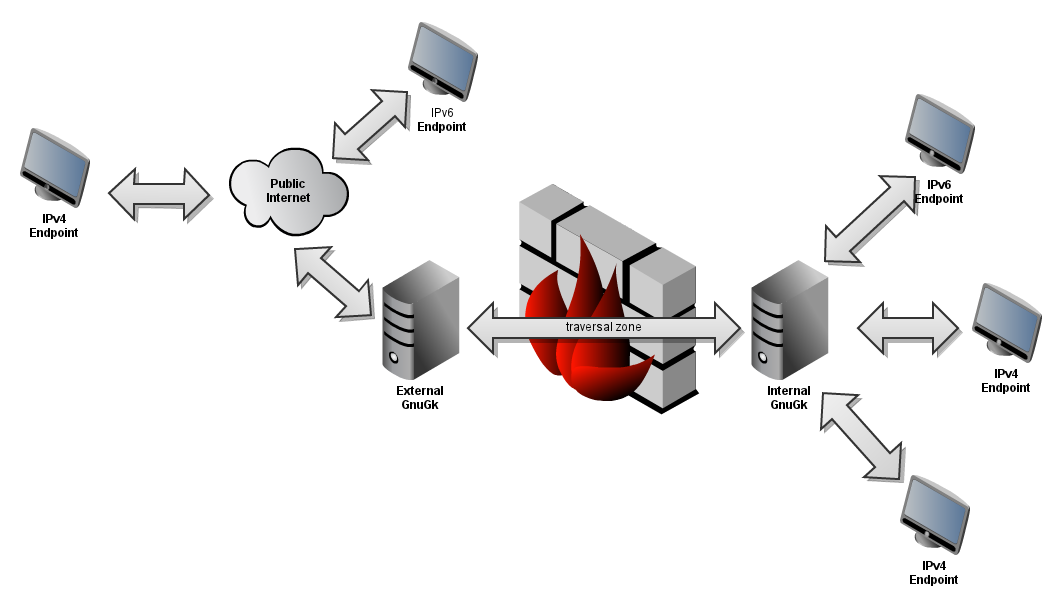
If you have very old endpoints that don't support support H.460 NAT traversal, you can still do this. You just need a 2nd GNU Gatekeeper inside your firewall that tunnels the calls out to your external GNU Gatekeeper on the public IP. (Hey, its a free, you just need a 2nd server!)

Replace infrastructure devices with a GNU Gatekeeper


Some infrastructure devices (gatekeepers, gateways, proxies etc.) need to be on public IPs and thus there is a risk of exposing possible security holes to the open internet. Many of those can be replaced with a GNU Gatekeeper. Keep in mind it can be configured to do many different things that ordinary gatekeepers don't do.


Wednesday, January 17, 2018

GNU Gatekeeper 4.8 released

GNU Gatekeeper version 4.8 has been released

This version has many new features. You can download the new version from
https://www.gnugk.org/h323download.html

Overview:

New maintenance mode: When you need to take down your GnuGk server
(eg. for an OS update), you can switch GnuGk to maintenance mode where
it will only allow ongoing calls to finish and automatically redirects
all idle endpoints to an alternate GnuGk server.
The status port command is "MaintenanceMode <alternate IP>".

Detailed information about ongoing calls: You can now display lots of
information about each ongoing call (codecs, bandwidth used, IPs etc.).
The web interface has been extended to to show this information.
See https://www.gnugk.org/images/web7.jpg

Easier installation on AWS and inside docker containers. You can now
let GnuGk automatically detect the public IP of your AWS server, even
from within a docker container. You can also automatically insert your
public/external IP into your trace file names to store logs from many
servers in the same directory.

Extended API: Call routing with external applications has been
expanded. You can now set the display names for participants and
desired reject codes on the status port. You can also access the
vendor information of all registered endpoints. The web interface has
been extended to provide this information, too.

HttpPasswordAuth has been greatly extended to fetch password
information from backend servers. We now use curl to support https
and you can add many new placeholders in your queries.

Extended screening and rewriting of display names and calling party
names.

Important bug fixes: Multiplexed RTP is now much more robust and
password authentication to parent gatekeepers has been fixed. There
are also interop fixes for TCP keep-alives.


Please see the full change log below for more details.

Changes from 4.7 to 4.8
  • HttpPasswordAuth: support https and add new placeholders
  • PrintAllRegistrationsVerbose now also shows the endpoint vendor
  • new status port command: MaintenanceMode
  • new status port command: PrintCallInfo
  • allow placeholder %{gkip} and %{external-ip} in [LogFile] Filename=
  • fetch AWS public/elastic IP if ExternalIP=AWSPublicIP
  • new commandline switch: -e / --externalip
  • extend status port command RouteReject to set reject reason
  • extend status port commands RouteToAlias, RouteToGateway etc. to set display IE for calling and called
  • new switch: [LogFile] DeleteOnRotation=1 to delete the old logfile when rotating instead of renaming it
  • new switches: [RoutedMode] AppendToCallingPartyNumberIE= / PrependToCallingPartyNumberIE= to add any string before or after the calling party number IE when ScreenCallingPartyNumberIE=RegisteredAlias
  • when [RoutedMode] ScreenCallingPartyNumberIE= is set to RegisteredAlias, GnuGk sets calling party number IE to the registered alias (forced screening)
  • delete DisplayIE when [RoutedMode] ScreenDisplayIE=Delete
  • new switch [Endpoint] Authenicators=
  • new default: [RoutedMode] GnuGkTcpKeepAliveMethodH225=EmptyFacility
  • new default: [RoutedMode] H460KeepAliveMethodH225=EmptyFacility for Cisco interop
  • new setting "None" for keep-alive methods
  • BUGFIX(ProxyChannel.cxx) fix bugs in H.460.19 RTP multiplexing
  • BUGFIX(ProxyChannel.cxx) don't send H.460 keep-alive to non-H.460 party when calling H.460 party
  • BUGFIX(Routing.cxx) show called port in RouteRequests (as documented)
  • BUGFIX(GkClient.*) fix password authentication with parent
  • BUGFIX(Routing.cxx) remove semicolon and pipe chars from vendor string in RouteRequests
  • better handling of IPv6 GRQ without RAS address
  • BUGFIX(ProxyChannel.cxx) turn off encryption proxy if DH key is negotiated, but TCS doesn't contain any H.235 entries
  • BUGFIX(ProxyChannel.cxx) fix running in proxy mode on FreeBSD when one Home IP is set
  • BUGFIX(ProxyChannel.cxx) fix DisableSettingUDPSourceIP=1 for Windows, NetBSD, OpenBSD and Solaris
  • BUGFIX(yasocket.cxx) fix LARGE_FDSET for NetBSD, OpenBSD and Solaris

Wednesday, October 4, 2017

Background: What is an RTP Bleed attack ?

now that hopefully everybody has updated to GnuGk 4.7 here is a little bit of background information on the latest security update:

RTP bleed is an attack that allows the attacker to redirect the RTP media stream (or parts of it) to his own IP without even having to manipulate any IP routing or being in a man-in-the-middle position. It also has good potential to mount a denial of service attack.

This vulnerability is not specific to GnuGk or H.323. It exists in a number of telephony products and RTP proxies. recently Asterisk was found to be vulnerable.

How is this attack possible ?

Originally H.323 announced all the ports that it intended to use inside the signaling and all was well. Then came firewalls and today most endpoints live on private IPs and have no idea what their public IP might be or which port the NAT router assigns then.

Thus H.323 introduced port detection in the form or H.460.19 which only works with registered endpoints and GnuGk extends that to unregistered endpoints with the IgnoreSignaledIPs=1 switch.

This works very well, but it means that GnuGk has to listen to RTP from any IP address and then send RTP for the other direction to what ever IP the sender appears to have. An attacker can now try to send its own RTP packets and trick GnuGk into believing they come from the call participants. And thats really easy, since RTP itself doesn't carry any form of authentication. When receiving such a malicious RTP packet at the right time, GnuGk
would thus send the media stream to the attacker.

The first step to reducing the attack surface is to stop allowing incoming RTP packets to change the send destination after the initial port detection is done. GnuGk has always done this for H.460.19, but not for unregistered calls until version 4.7.

Unfortunately this still leaves the possibility for an attacker to try to send RTP packets before the real call participants do. And since RTP is UDP, it can easily be sent with a spoofed source address to turn this into a hard do defend against denial of service attack.

Since H.323 doesn't make any requirements where RTP will come from, you can't defend against this remaining vulnerability without disrupting some valid configurations.

But is most cases RTP will come from the same IP or at least the same network where the signaling comes from. Thus GnuGk introduces a new switch in version 4.7 so you can tell GnuGk to only accept RTP from these IPs (RestrictRTPSources=Net). Thus an attacker would have to be inside the calling parties network to cause harm which is way more
difficult that to be just anywhere on the internet.

If you use a load balancer or routed mode gatekeepers distributed over multiple networks, you need to take more elaborate steps to secure your network, but the vast majority of users should be able to secure their configurations with RestrictRTPSources=Net. Since we violate the H.323 standard a bit here, the switch is off by default and you will
need to set it explicitly.

I hope this clarifies the issue and explains why you should update and secure your configuration!

Thursday, September 21, 2017

GNU Gatekeeper 4.7 (security update)

This version is purely a security update and has no new features. All users are encouraged to update, especially if you use port detection (IgnoreSignaledIPs=1) you should update ASAP.

It has been discovered that GnuGk is vulnerable in some configurations for RTP bleed attacks (https://rtpbleed.com/). By updating to version 4.7 only the first packets in each media stream influence the media destination.

To further secure your configuration, you can set

[Proxy]
RestrictRTPSources=Net


to only accept RTP from the same class C network that the call signaling came from. Please beware that this may break a few valid calls where this condition isn't met.

You can download the new version from
https://www.gnugk.org/h323download.html


Please see the full change log below.

Changes from 4.6 to 4.7
  • fixes for RTP Bleed
  • new switch [Proxy] RestrictRTPSources=IP or Net to limit accepting RTP from the call signal IPs or the respective class C network
  • new switch [Proxy] LegacyPortDetection=1 to keep port detection help for some very old and broken endpoints that will make your gatekeeper vulnerable to RTP Bleed attacks
  • BUGFIX(ProxyChannel.cxx) replace @ip or ip## from aliases when using RedirectCallsToGkIP
  • BUGFIX(ProxyChannel.cxx) better initialization of sendmsg() structs
  • new command line option: now you can use -S instead of --strict (needed on BSD systems)